
Creativity is an Impulsive Energy
Interview with Chloe Yune

This interview is part of a series of conversations around building and sustaining Creative Community Research Partnerships in Athens, Georgia (USA). It was funded by the Teaming for Interdisciplinary Research pre-seed program from the Office of Research of the University of Georgia (UGA). This interview took place on December 15, 2023, on the UGA Athens campus.
The interviewee is Chloe Yune. The interviewers are Anna Abraham (E. Paul Torrance Professor; Director of the Torrance Center and the Creativity & Imagination Lab) and Eliana Gelman (Undergraduate Research Assistant at the Creativity & Imagination Lab). The interview transcript and recording were prepared for the Creating Creative Communities Substack by Hailey Covarrubias (Undergraduate Program Assistant at the Torrance Center).
Chloe Yune is an artist and a third-year student at the University of Georgia. She works in ceramics as well as drawing, painting, and various forms of crafts. She deeply values creativity, seeing it as a vulnerable yet joyful necessity that extends beyond just the arts into all aspects of life.
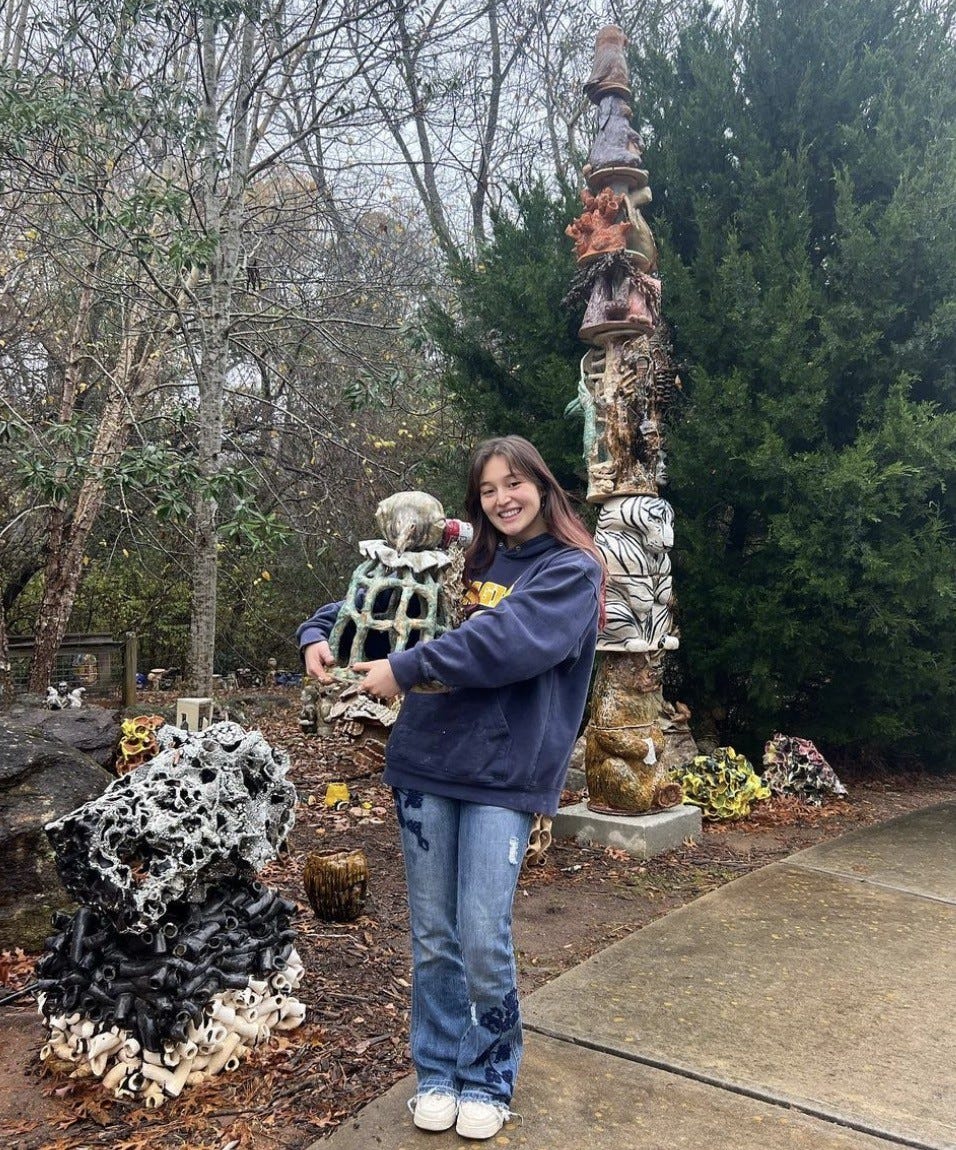
Read the full interview below:
[Interview has been shortened and edited for clarity]
Eliana Gelman:
This is another recording of our Creative Community Research Oral History project. I'm here with Chloe Yune. Can you introduce yourself and talk about what you do?
Chloe Yune:
I'm Chloe, a third-year UGA student. I study ceramics primarily, but also do drawing and painting. Ceramics is my emphasis. So big ceramics girl. Yeah, that's what I do.


Eliana Gelman:
How long have you been in Athens?
Chloe Yune:
This is my third year in Athens. I grew up in Indiana, but my dad lives in Georgia, so that's what kind of brings me down here.
Eliana Gelman:
What has your creative journey in Athens looked like, and how long was this a part of your life before you moved here?
Chloe Yune:
Creativity has been part of my life since before I even understood what it was or what it meant. The Athens creative community has been really cool for me in terms of feeling at home here. Something I love about Athens is how there's this scope of types of people that are contained within. It's like a tiny little ecosystem.
I remember first getting into UGA and feeling like I didn't know how I was going to find my place. I was like, wait, SEC, sorority, Greek life. I don't know, just being a little art child. So, I think coming to Athens and then exploring the very creative little pockets of Athens has made it feel a lot more like home. I feel more comfortable because of them.
Eliana Gelman:
We just talked with Montu Miller about how the art community in Athens is not unified. There's division in terms of the type of people who are interacting with each other. It seems very segregated, including the university community and the rest of Athens. I'm curious about your being a part of the university ecosystem, but finding creative community outside of that. How have you found yourself in these spaces? How did you know where to look? How did you come about the places that make you thrive creatively?
Chloe Yune:
I kind of feel like it's more of a both/and situation. The UGA art community, I don't really have any choice but to be involved in that because that's my school. The Athens community, they go really hand-in-hand with the UGA art community and then the broader Athens community because I think art students especially are seeking out art things beyond school in a way that's maybe unique to that program.
Honestly, most of the art things that I've been involved in in Athens have found me through other creative people. I'm thinking about when we went and painted that mural at Bigger Vision. Just more stuff like that. There are constant creative pursuits happening all around Athens. Sometimes I just happen upon them, and then I seek them out through other art students or other creatives that I know. I don't ever feel like I have to look too hard to find them.
Eliana Gelman:
You mentioned not knowing what creativity was before. How has your understanding of creativity changed over time? Can you give us a broad definition of how you see creativity and how it manifests in your life?
Chloe Yune:
That's a good question. I've been thinking more about creativity and all that it contains lately as I spend more time just thinking about art in general. When I was young and expressing myself in whatever medium, I wasn't thinking about it explicitly. The way I think about creativity has become more explicit now as I'm older, more intentional.
As an art student, I'm kind of planting roots in a field that is totally contingent upon creativity. I think now I am more aware of the gravity that creativity carries. I spend my time thinking about it, whereas I didn't think about it when I was a kid. I was thinking about Harry Potter and what I was going to eat for dinner.
I think creativity contains more than I thought when I was a kid. I'm more aware of the hard parts of creativity now.
Eliana Gelman:
What are those hard parts?
Chloe Yune:
I would say being creative has drawbacks. There's a more positive way of looking at it, which is that creativity is a huge strength and not everybody has it. I'm more aware of that now and more aware of how it makes me unique.
I don't know about people who cannot be creative. I think it comes more naturally to some people. I think everybody can access creativity. It's sort of like an energy in that way and it's all around. People can tap into it, but some people have to go more out of their way to access that side of creativity.
There are certain things I really struggle with in terms of organization. There's an impulsivity aspect of creativity, which is very true for me at least, but it sometimes bites me in the butt because I'm not thinking things through. Creativity is kind of a double-edged sword in some ways, but it works for me in my field.
Eliana Gelman:
What does accessing creativity look like for you? How does it come up?
Chloe Yune:
Creativity. It's just so fluid. To me, creativity is kind of like a feeling. When I was a kid, it was just something I experienced. Creativity to me always carries some sense of newness. I said impulsivity. There's definitely an energy to creativity and an active component.
When I think of creativity, I think of generating, making new things. When I think of the most creative people in my life - other artists I admire, other art friends, and not even just in art, but people who are creative - I think of people who are really ready to step away from what's been done and into something new.
There is definitely a vulnerability there. To be creative requires a lot of trust in yourself. In that sense, creativity is inherently brave because you're stepping away from what's been established and what's been done into something that very well could fail. That's just part of doing things that are new and that haven't been done before.
Eliana Gelman:
How does creativity manifest in your daily life beyond art?
Chloe Yune:
Creativity affects every single area of my life beyond just the art that I make. One example that comes to mind is this past summer when I was working with kids as a camp counselor. Any time you're with children, creativity is going to be involved. Children are so naturally creative and imaginative.
I think what I was getting at about creativity having bravery––I think kids have that because they have fewer preconceived notions about what the status quo is and what should or shouldn't be done. Kids are not afraid to step out and try something new because they don't think as much as adults do about what is acceptable and what is going to fail or succeed.
So, when I was a camp counselor, hanging out with these kids all day and coming up with things for us to do, I was thinking creatively. They force it out of you because you have to match their energy. I think the way I do relationships, like friendships and all relationships, has a creativity aspect too.
Creativity touches every part of my life. It's hard to put a finger on it. I think if I were to watch myself through a third-person perspective, it would be easier to see. To me, it's just, at this point, so inherent that it could be like something routine, so natural that you don't even think about it. That's how I feel about thinking creatively. That muscle in my brain is always ready to activate.
Eliana Gelman:
There’s a lot of parallels in the commentary you are making with what Montu Miller and Dr. Abraham and I talked about, because he does work as a teacher for AP students. They're usually 11th or 12th graders, so a little bit older than the students that you were working with over summer. He was mentioned these inhibitions that kind of start around when you start becoming a teenager and then you are so hyper aware of the way you're perceived and the way you appear in the world.
It's exacerbated by social media and that people are not willing to be wrong. People are afraid of saying the wrong thing, afraid of showing up authentically, afraid of crossing this boundary with one another. Where you just reach out and you look at the person next to you. You have a conversation. And that is kind of part of creativity. Before anything creative can happen, we have to able to do that.
The younger kids you worked with don't have those inhibitions. There's like a childlike play involved sometimes in creation and doing something that's new or daring. Do you have any examples of things in summer that happened or other experiences you've had where this really does exemplify it? Or you were like, this is it?
Chloe Yune:
I think there is a fearlessness that has to come with creativity. And I've just seen over and over again, especially working with kids, that kids don't have to try that hard at that fearlessness.
This is a really silly and small example, but to me perfectly encapsulates creative thinking. You're going to laugh. I'm thinking about when you and I had Friendsgiving. We were making a little labels for cheeses on a charcuterie board for Friendsgiving. And we didn't have like popsicle sticks or toothpicks, so Eliana chopped the parts of dumdums, like the lollipop. And we used them as cheese flags. That could like be half resourcefulness, half creativity, but to me that was a moment where, I don't know, I first of all, I fell in love with you in that moment because you are perfect. It is so inherently creative because you're like, okay, let's look in unexpected places for something that we can use and step away from what is normally done. And it worked.
When me and my sisters were growing up, and we would go to a playground down the street from my house and we would play pirates for like literally hours. And all we would do is assign ourselves roles. I was normally the one who could talk to animals, or I was the chef. That was my pirate role.
Eliana Gelman:
The two real superpowers that you now embody.
Chloe Yune:
It makes perfect sense. I would like to chop up little pieces of grass and put them all in a bowl. Its impressive the way that kids think and how easy it is for them to access that imaginative world and just like suspend their disbelief. That is creative.
Eliana Gleman:
What kind of creative endeavors have you been involved in throughout life and what drew you to them? It sounds, in the way you talk about it, like it happened upon you, like you had no choice.
Chloe Yune:
That's how I feel about art in my life. I am of the belief that there a lot of people who can do many different things and be content and satisfied. I think I would have enjoyed working with wildlife or doing journalism. But also, I think no matter what country I was born in, what year I was born in, if I had my brain, I would not have been able to escape art. It has chased me through my life and it has found me over and over again. It's like I just find myself turning to it anytime I am feeling anything that I need to share or express or get out of my brain. I don't know. It feels like a part of me that I couldn't shake if I wanted to. So, it's a good thing that I don't want to.
Eliana Gelman:
What is that like when it finds you again? Or how has that happened for you?
Chloe Yune:
That doesn't really happen as often now that I study it in school, but in the past, it's kind of like reconnecting with an old friend and it feels so natural and easy. I think the way that anybody's passion should feel to them, maybe like putting on an old jacket that you’ve worn a million times and it's just like, “oh yes. I love you and I missed you.”
Also, it shows up in small, unexpected ways in my life. I am an obsessive to-do list maker because I have ADD and I need them to eat, sleep, breathe. My friend was looking through some of my to do lists and he was like, “you should like put these in a museum.” I didn't even realize I was doing it, but every single one of them is like, covered in sketches and doodles and, like, decorated, beautified. It would be so un-Chloe to just have a plain list of my to do list items. I find myself like seeking beauty in most things and beautifying all my belongings. I like it. I look for beauty in a lot of things.
Eliana Gelman:
Is the ease of outward expression the same across mediums or does it change?
Chloe Yune:
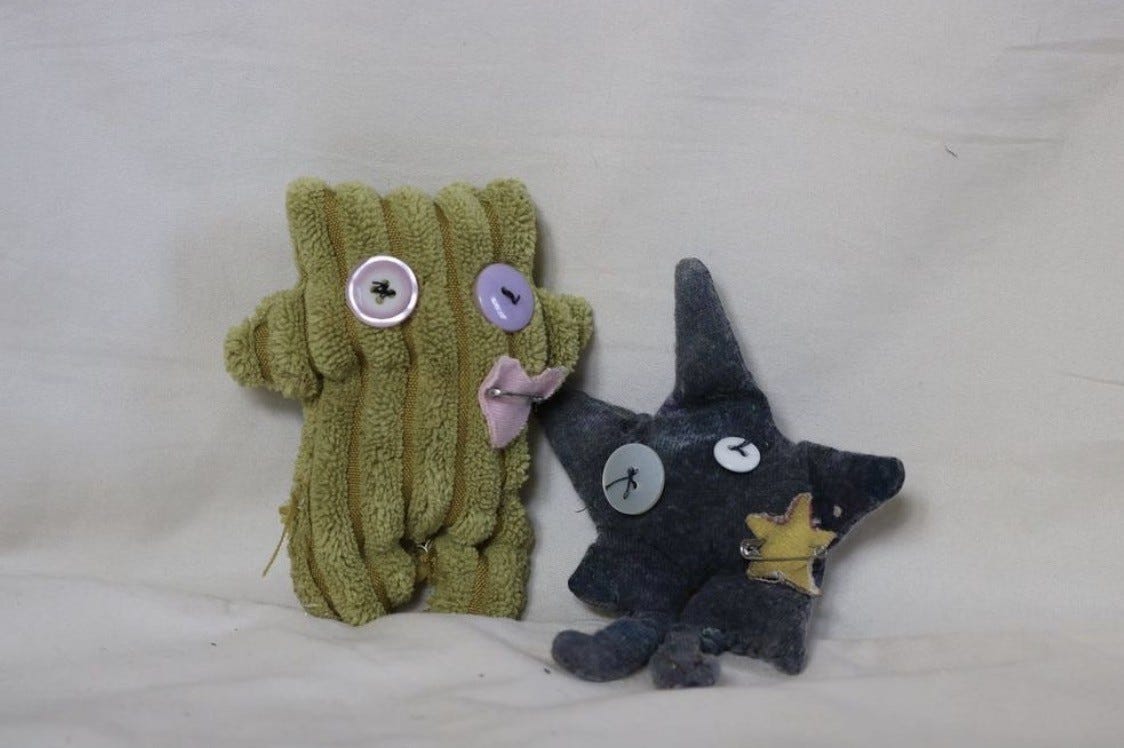
These are pertinent to my life right now, so I love talking about them. Regarding mediums, let me rattle off some that I've worked with: ceramics, painting, printmaking, drawing, to-do lists, magazines, jewelry. If it's arts and crafts, I can pretty much guarantee that I've done it. When it comes to the differences across mediums, I could get broader. This is just material or visual art.
Eliana Gelman:
There are many ways that art exists, is made, and serves purposes. And I think undoubtedly one of those purposes is just beauty. It's something I personally struggle with because to value beauty, to value making something to be beautiful, doesn’t feel like enough. I want to have the idea that anything that is an expression is worthy and enough, right? But I don't know sometimes. What do you think is the purpose of art? As I also notice, in your practice, you don’t make the distinction between art and craft.
Chloe Yune:
I absolutely don't. That's an important conversation to have because it gets into patriarchal ideas of art. Crafts have historically been associated with women and not taken seriously for that reason. I think it relates to what we're talking about because crafts carry a sillier or more casual tone than "boom, art." It's all expression. It's all beauty and making, creativity, generation of ideas and expression. It does have value, which I know we're talking about - the difference between just saying that and feeling it and living it. I don't think about arts and crafts versus art differently. I think if you're making it with your hands or enjoying making it for people, it's all art in my opinion.
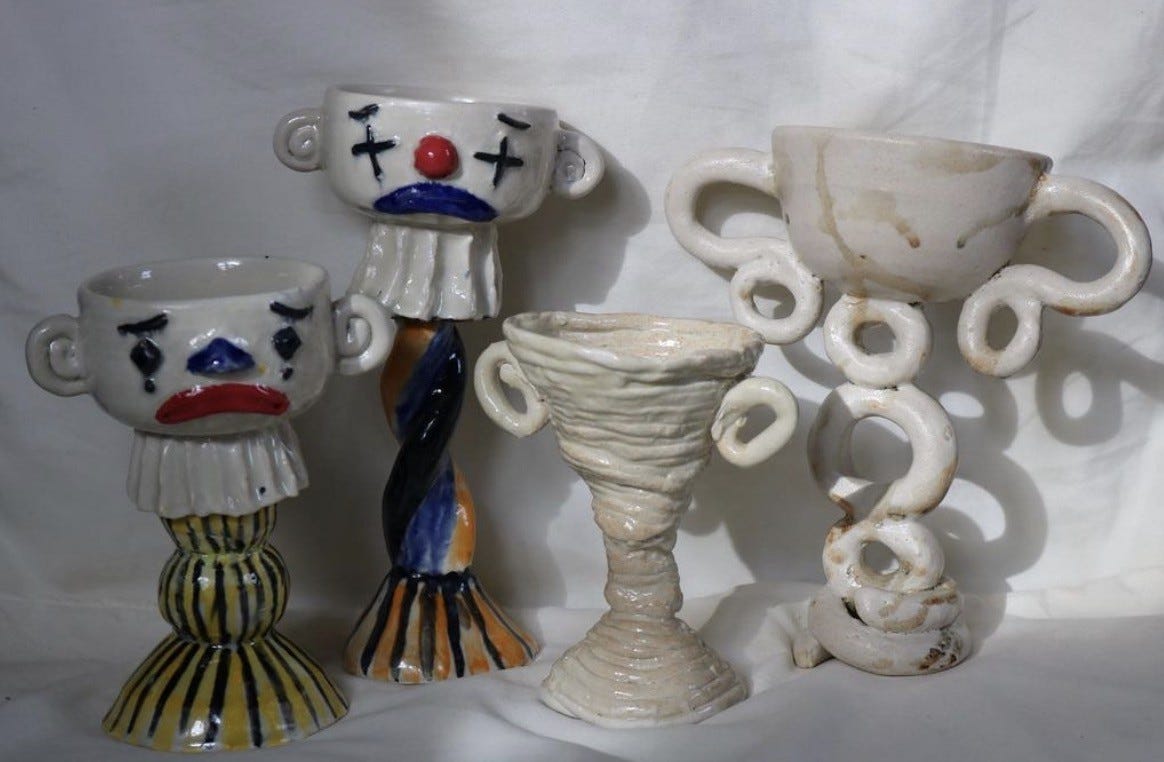
I notice similar trends in my art process regardless of medium. Most of them have to do with time. Based on the speed I'm working at, there's usually an impulsivity stage, which is the mapping out of ideas, the rough foundation-laying stage. In ceramics, it's the wet clay stage where I'm roughly sculpting everything. In drawing, it's blocking out or sketching. In painting, it's laying the initial colors down. Then there's the assessment and refinement stage where you're adding detail, really sitting with your piece. That stage doesn't come as easily to me as the initial stage, but some people excel at it and struggle to loosen up enough to get through the first stage. There are patterns I notice across every medium, and I think it takes creativity to do both stages. I think the creativity is especially crucial in the first stages when you're barfing all your ideas up onto a piece and making them.
This may be an ADD thing, but pretty much as soon as I'm done with the initial push, I'm done. It's usually my teacher who will tell me, "What if we push this a little further? Let's finish strong on this one." I'm thinking, this is on the kiln cart. I am not taking that back off. It's rough edges and scraggly bits.
Eliana Gelman:
How do you balance the fact that most forms require so much patience? The way that you talk about art, and the way that I kind of see it too, sometimes it's a raw and extremely time-sensitive expression. If what you feel in this moment is what you are putting it out into the world through art, the next moment can feel entirely different. How do you push through projects that are based on something so fleeting? Is creativity really like that? Does art have to be this outward, self-centered push feels?
Chloe Yune:
There is a part of that that's necessary. That's what people connect with and resonate with. I think the most heavy-hitting art that I have witnessed has been maybe the most intimate to that artist.
What you said about the word "fleeting" feels accurate to me. There's always a slight tinge of panic to that initial stage in the creative or art-making process. There's an adrenaline to it where you're thinking, "Quick, get everything out." You have to set yourself up for the refinement stage, otherwise, you'll lose it.
I don't know if that's creativity or what that is. For me, it's like what I imagine doing a line of coke is like. There are stages of creativity. I did this big sculpture for my final last semester, and I think I did probably 80% of it––of the building stage––in 45 minutes. That's not normal. That is especially fast. To me, that's where the creativity is really driving the work.
Eliana Gelman:
I feel like there's something creative, too, about sitting with it. Something creative about having to hijack your brain. It takes creativity to say, "This is something that is incredibly hard. I love it. I want it. And I love it."
Chloe Yune:
I do so much of that in my day-to-day. My brain is not ideal for being functional in a lot of ways, at least in the society and culture that we live in. Being a student and having deadlines, I was kind of set up for failure with my brain. I need it, obviously, to do the work that I do, and I'm grateful for it and I love it. Sometimes. It does take a lot of creativity to make it work. That's why I do my to-do lists and think about how I can make this as helpful as possible.
Talking about this is making me think of something more existential and broader, which is that it kind of takes creativity to love your life. Being alive is hard sometimes. There are a lot of painful things. I guess I am still a baby in so many ways, but college is hard. So much change happens and you feel hard feelings all the time. You have to think creatively. This also ties into talking about beauty, which we were discussing earlier. If I never thought outside the box and went out of my way to diversify my day or inject a little beauty into my life, I think I would hate my life because it would be so bland. It's a survival tactic. I need creativity to love living. And I do love living so much because I actually have to force myself to see beauty where most people maybe won’t. That takes creativity, in my opinion.
Eliana Gelman:
Everyone we've spoken to on this project is somehow involved in the creative community in some way. They make art, music, or work with artists or musicians. The common thread is making. The people who work with creatives, they’re often still makers––makers of spaces, makers of opportunities. I think that is the first thing you said here on this interview, that creativity is making something new and it's a way of thinking.
However, there's a huge divide between visual art and other forms. The way that it's both made and consumed is very solitary for the most part. And this is changing, but generally, it's you and your work and your material isolated, and the work is consumed in a gallery, maybe alongside others but often it's still a personal experience. Of course there's all kinds of interactive work. But I'm generalizing here because you don't have this kind of pattern with something like music, where the whole point of it to gather and share shared consumption in a space. Part of what this project is looking at is creative community. What role do other people play in what you do, as a visual artist? How does the Athens creative community affect your life and how do you affect it?
Chloe Yune:
Visual art can be very isolating. The good part of that is the intimacy and personal aspect we talked about earlier. But I would love to see more of a community aspect to art. In terms of collaborative art, I haven't done a ton, but I would love to do more. The first class I took at UGA's art school was a collaborative art class, and that's the reason I became an art major, which I wasn't initially planning on
It was my freshman odyssey with Professor John Swindler. It was me and a bunch of other students, and I think I was probably one of the only future art majors in the class. The rest were just random students who needed an odyssey credit.
Eliana Gelman:
Can you tell me about that class? What was it like working in an environment with non-artists?
Chloe Yune:
It's definitely clunky and awkward for people to express themselves through art if that's not something they're used to. But there's a joy there and a playfulness that comes out in almost everybody. It's unlike anything you do in your normal day-to-day life. Being creative brings joy because it's inherently childlike, and children are joyful. It's fun to express yourself through art. Getting to see people do that when they haven't in a long time is especially cool.
There were definitely moments where I thought, "You guys don't really care about art”, or people who aren't used to art are like, "Meh, don't care." They just don't think as much about the gravity of it as people who are in art do and just question its validity. It's like, "What is the point?"
Let me paint a picture. This was our last project for the class, and we needed to do a performance piece. We all sat in a big circle. I was the one who walked around the group with a roll of tape and taped everybody together. Then for a minute, we each made a different animal sound. That was our piece. There's a serious ridiculousness about it. The same with a banana taped to the wall. The ridiculousness is a necessary part of art sometimes. People don't take it seriously, and sometimes that's okay. I think something can be ridiculous and still have weight at the same time. There's a lightheartedness, which is often neglected in art - the silliness or not taking it so seriously.
Eliana Gelman:
I think in the same breath, it's an avenue for joy but also for things that are difficult or painful. You're now pursuing it in an academic context where there are all these external pressures. How do you deal with all those things in combination?
Chloe Yune:
For me, I know of art students who find the deadlines crippling or that it hinders their artistic process. For me, I think it's only served me. I sometimes feel more watched when I'm an artist in school, and there are more parameters because you're getting graded. I find myself thinking too much about whether my piece is going to awe and amaze. I don't know that I should be as concerned about it as I am, but I've never experienced making art as intentionally, seriously, and thoughtfully as I do now outside of school.
I learn so much every single day being in art school. If being an art student is putting me in a little box for right now, I'm okay with that for the payoff, which is having the teachers that I have who teach me as much as they do. As an artist, you have a responsibility to trust your own instincts and then take what is helpful and leave behind what is not helpful, especially in critique. I think I will probably feel less pressure to make "good" art once I'm no longer in school. For now, just because of everything that I learn in class every day, I think it's worth it. I learn a lot and I have good teachers.
Eliana Gelman:
Are there other ways that creative collaboration has shown up in your life? Do you want more of it? And what can you speak to about the Athens creative community?
Chloe Yune:
With my limited experiences of collaborative art, I've noticed that the shared vulnerability in creating something collaboratively is a very bonding experience for everybody involved. It makes it less scary. When everybody is matching each other's vulnerability level, it makes the whole place feel safer and easier.
In terms of other creative, collaborative communities in Athens, there's an underlying mutual understanding. It's not so much "Oh, I see you're creative," but more of an acceptance. I feel very safe and accepted in creative communities because they're diverse and the shock threshold is much higher. I’m thinking about like the person who dressed as a flamingo at Treehouse Zine event...it didn't really faze me at all. This is normal.
There's something comforting about people not being afraid in a group setting to express themselves. That's something really special about collaborative art, and for that reason, I would love to do more of it.
Eliana Gelman:
Would you ever see yourself doing things with performance or interactive art that necessarily involve people?
Chloe Yune:
Performance art intimidates me a lot. I already struggle to put my soul into the things I make. I'm thinking about the big load of pots I just took out of the kiln. I poured my heart into them. Some are more cryptic than others, but all of them represent very real feelings. There's a whole other level when your actual physical body is in the piece.
I would want to do it as a way of pushing myself out of my comfort zone. It's scary, and I really admire artists who go out onto the street, talk to strangers, and do things that are truly fearless. It's already fearless because it's creative.
Eliana Gelman:
Why do you think you gravitate towards your medium? You talked about the physicality of it. There's a lot more to ceramics and ceramic sculpture. Can you elaborate on that?
Chloe Yune:
Oh my gosh. I love ceramics. I could talk about it for so long. The physicality is a big part of it. Something about ceramics goes really well with my way of doing art because it is so physical. There's just something about working with your hands so directly. I've seen so much beautiful art, and I'm a crier, but to see a pot that someone has poured their heart into - it's the best medium for expressing hard feelings, I think.
Ceramics offers a cool way to bring art into objects that we already have and use. I talk about that a lot when it comes to sustainability. So much of my art has to do with recycled materials and thinking sustainably about how we can produce less material in the world.
I love a painting, and I'll hang one up in my house any day. But I think it's so cool and beautiful to bring design, joy, and beauty into your cup that you drink coffee from, or things that are used in your day-to-day life. It allows art to infiltrate everybody's little personal world.
Eliana Gelman:
Your art reminds me of Huey Lee. You both do the illustrative and storytelling ceramics. He said the clay is a part of you. It's a material that you have to wrangle with a lot more than you would with something like a canvas.
Chloe Yune:
Clay has changed me. I feel like the clay. Clay has a soul of its own. It remembers... clay has memory. It wants to do what it wants to do. Sometimes I think of ceramics as a partnership with clay instead of, I don't know, like a painting or drawing.
Eliana Gelman:
That’s a nice full circle thing for us. That's your creative community partner.
Chloe Yune:
For real. I do collaborative art every day. The clay's got hands. I have to listen to the clay, otherwise it's all going to crash and burn or explode in the kiln.
Eliana Gelman:
What is the value of creativity in community? How can we cultivate it and why should we?
Chloe Yune:
First of all, there's strength in numbers. I would love to see more artists uplifting each other in the Athens art world. I think there's a competitiveness in the art world that really saddens me because art already needs to be protected. In the direction our world is heading, art needs to be protected. It's so vulnerable, and people just don't take it seriously sometimes.
When artists are validating other artists and taking their work seriously, it shows other people who maybe aren't in the art world that this is worth looking at, paying attention to, talking about, and thinking about. The word "solidarity" comes to mind. Artists really need to support each other because we are vulnerable.
I mean, I already touched on people supporting other art people. There are a million ways you can support other artists. I love buying my friends' work or promoting it through social media. Social media is a tricky world to navigate in terms of art, but signal-boosting other people's art is such a cool and special thing. Asking people questions about their art is a really good way to support it because I feel so supported if someone cares enough about my art to think about it further and prod my brain in that way.
I would like to see the scope of the art world in Athens expand a little bit in terms of bringing in more people who aren't as familiar with art. A beautiful thing about art events in Athens is that I see art people who I love, and I see familiar faces often, but it would be really cool to see people you wouldn't expect to see at an art gallery. I think people would love art if they only knew where and when it was happening, and how to take part in it.
Ultimately, the effort towards seeking it out matters. It's hard to put myself in that position because I've been doing it for a long time now, but I can see how for someone who is completely new to anything creative, it could be intimidating to go to an art event. I think art people need to invite non-art people to art things. That's a practical step.
Eliana Gelman:
Is there anything else you think we should know about creativity?
Chloe Yune:
I guess just that, as I said earlier, anyone can access creativity. Even if you're somebody who thinks it doesn't come naturally to you, you've got it. You just have to tap into it. I want to teach, and that's such a big part of teaching - that art is for everyone. Art is not just for "art people." Being creative is not just for so-called "creatives."
Creativity has carried me through my life over and over again. I love thinking creatively, and I feel like more people should experience that. I would love for people to know that they are capable of that.
Eliana Gelman:
Well, thank you so much for talking with us, Chloe, and sharing your thoughts. This has been so lovely.
Chloe Yune:
Thank you for having me.
Instagram: @chloeyuneart